
The SEOWEBI Visibility Framework
A structured model for measuring how AI systems recognise, trust, and recommend brands when generating answers.
AI visibility must be measured before it can be managed.
Search has changed.
Measurement has not.
For two decades, visibility was measured through rankings, traffic, and impressions.
That model assumed users would click, compare, and decide.
AI systems changed that model structurally.
They generate answers. And those answers include only a small number of brands.
Visibility is no longer about position. It is about inclusion.
Most measurement systems were built for position. They have no column for inclusion.
If your brand is not included in the answer, you are not part of the decision.
The layer most companies are not measuring.
Most analytics dashboards still report what happens after discovery — traffic, clicks, conversions.
AI visibility exists before that. It is the layer that determines whether discovery happens at all.
It is determined by whether AI systems recognise your brand as a known entity, trust your information as accurate and authoritative, and select your brand as part of an answer.
None of those three conditions appear in a standard analytics stack. No column. No alert. No trend line.
This layer is rarely measured. But it now shapes who gets discovered.
What you measure today
This gap is not in your reporting stack
What determines AI visibility
The six layers of AI visibility.
The SEOWEBI Visibility Framework breaks AI visibility into six measurable layers. Each layer is a distinct signal set. Each contributes to whether AI systems can understand, trust, and recommend your brand.
Performance and Access
Your digital infrastructure must be accessible, indexable, and fast enough for AI systems to retrieve and process at all.
If AI systems cannot access your content reliably, all other layers are irrelevant.
Structured Content Architecture
Content must be organised in ways that allow AI systems to extract meaning — not merely display pages to users.
Extraction is different from ranking. Content optimised for one is not automatically optimised for the other.
Entity and Schema Foundation
Your brand must be clearly defined as a stable, consistent entity with recognisable signals across the web.
AI systems reconstruct brands from entity signals. Inconsistency creates ambiguity. Ambiguity reduces citation.
Topical Authority and Expertise
Depth, demonstrated expertise, and credibility determine whether your content is trusted as a source worth citing.
Authority is not claimed. It is evidenced. AI systems look for external validation, not self-description.
AI Citation Readiness
Content must be structured to be cited and reused inside AI-generated answers — not merely indexed for search.
A brand can rank well in search and still be uncitable. These are different structural requirements.
Brand Authority and Demand
External signals, brand recognition, and independent demand influence whether AI systems prioritise your brand in answers.
At L6, the question is not whether AI can see your brand. It is whether AI considers your brand worth recommending.
These six layers work together. Strength in one does not compensate for absence in another.
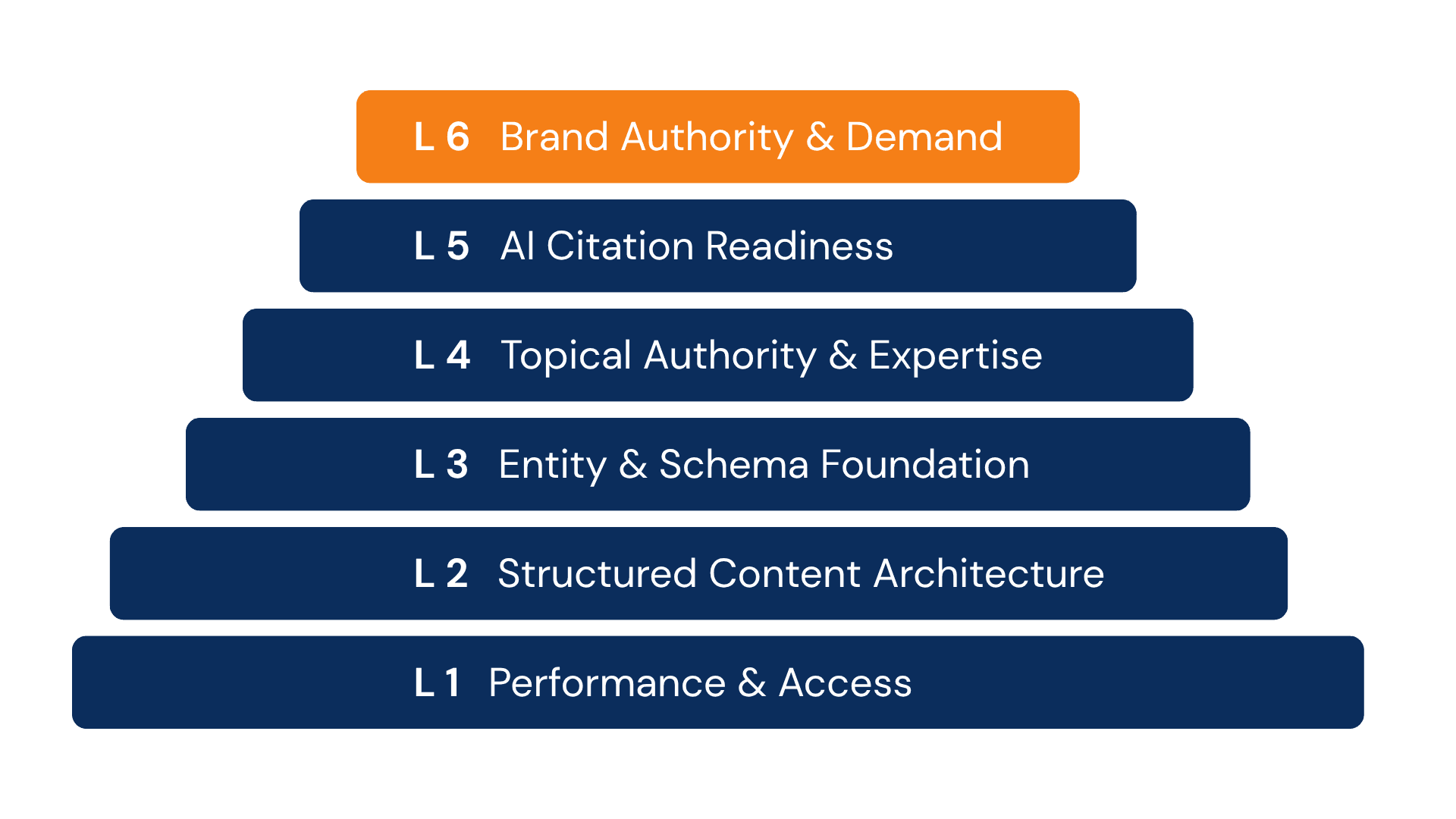
Visibility is not created in one layer.
The six layers are not independent checkboxes. They are a dependency system. Each layer creates the conditions for the layer above it to function.
When a layer is weak, the signal chain breaks — not just at that layer, but at every layer above it that depended on it.
The Dependency Chain:
Strong performance without entity clarity
AI can access your content but cannot identify who it belongs to
Clear entity without topical authority
AI recognises your brand but does not trust it as a source
High authority without citation readiness
AI trusts your content but cannot extract from it cleanly
Citation-ready content without brand demand
AI can cite your brand but has no external signal to prioritise it
AI systems do not evaluate one signal. They reconstruct your brand from all available signals simultaneously.
AI systems do not visit your website.
They reconstruct your brand from what they have already learned.
That reconstruction draws from structured data in your code, content across your pages, external references from other sources, consistency of signals across the web, and patterns learned during training.
Your website is one input. It is not the only one. It is not always the most important one.
This means that what you believe your brand is — and what AI systems have reconstructed your brand to be — can be significantly different. That gap is invisible without measurement.
The reconstruction is already happening. The only question is whether it is accurate.
Where visibility breaks down.
Most brands do not fail at every layer simultaneously. They fail in specific, recurring patterns. The same failure modes appear across industries and categories.
Naming them is the first step toward measuring them.
Comparison Risk
Most common in competitive B2B categories
Absent from comparison answers. When someone asks an AI system to compare solutions in your category, your brand is not included. You are not considered. You are not ranked lower. You are simply not there.
Incumbent Squeeze
Most visible in categories with 2-3 dominant incumbents
Excluded from the citation loop. Established brands dominate AI citation patterns through accumulated reinforcement. The more they are cited, the more they are cited. Newer entrants are excluded before they can enter the rotation.
Extraction Failure
Often misdiagnosed as an authority gap
Invisible despite existing content. The brand has content. The content is indexed. AI systems cannot extract clear, citable answers from it. The failure is structural — a content architecture problem, not an authority problem.
These patterns are measurable. They are also correctable — once they are identified correctly.
How this framework is applied.
The SEOWEBI Visibility Framework is the measurement architecture behind the AI Visibility Diagnostic.
Every diagnostic runs thirty prompts across four AI systems, evaluating your brand against all six layers of the framework. The output is a structured report that shows where visibility is strong, where it breaks down, and which failure pattern applies.
The framework is not a checklist. The diagnostic is not an audit. Together, they produce a measurement — a score, a breakdown, and a sequenced plan for what to address first.
The goal is not understanding. The goal is measurement.
Ask Aria.
Aria is the SEOWEBI AI Visibility Analyst. On the framework page, its role is different from the checkout. Here, it answers questions about the framework itself.
Ask Aria how a specific layer applies to your type of business. Ask which failure pattern is most common in your category. Ask what the dependency chain means for a brand at your stage. Ask which layer to prioritise if you could only fix one.
Aria does not prescribe. It explains the framework and connects it to your situation.
Most brands assume they are visible in AI.
That assumption is rarely tested.
Aria is trained on the SEOWEBI Visibility Framework. It does not store or share your conversation.
Measure your visibility.
Understanding the framework is the first step.
Measuring where your brand sits across all six layers is what creates clarity.
The diagnostic does that measurement. It tells you exactly where you stand — not in theory, but against the AI systems your buyers are already using.